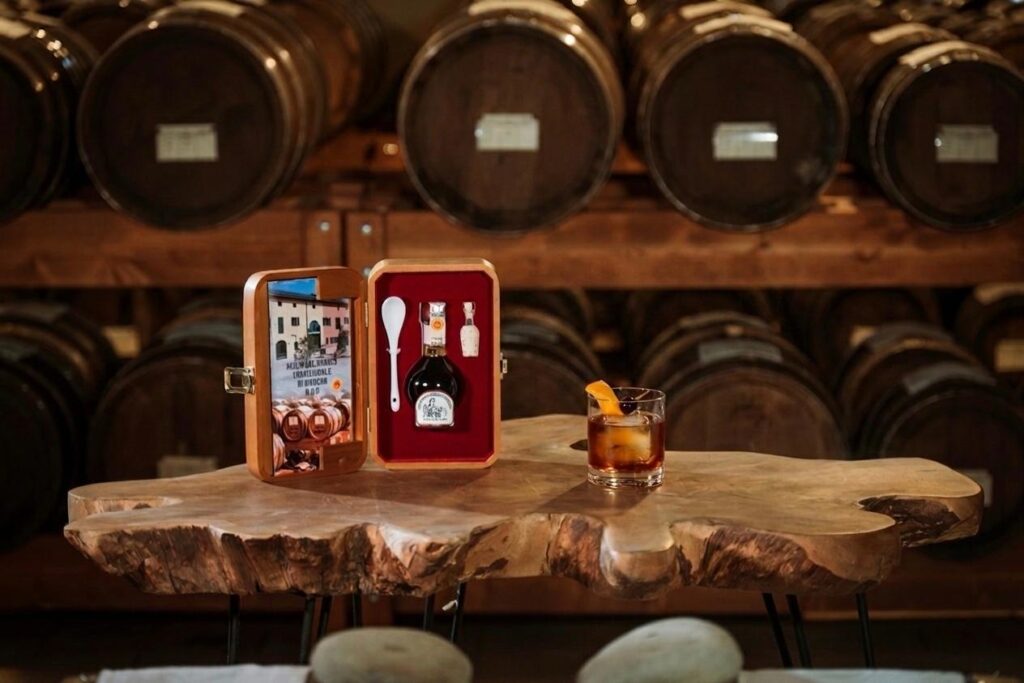
The Traditional Balsamic Vinegar of Modena DOP is a traditional condiment produced in the areas of Modena, made from the must of local grapes, and aged for at least 12 years. Its aroma and flavor make it one of the symbols of Italy today, suitable for enhancing numerous dishes, giving a truly unique touch to both sweet and savory preparations.
However, not everyone knows the story behind this “black nectar.” For example, many people are unaware that the adjective “balsamic” was associated with vinegar because the original use of the product was as an antiseptic to soothe sore throats and as a digestive aid for stomach issues. Additionally, it was believed to combat the plague as well.
The Family Tradition
The Balsamic Vinegar of Modena DOP is a true tradition for all Modenese people. In fact, just as oil is produced in other regions, in Emilia Romagna, and particularly in Modena, vinegar is produced. It is still not uncommon today to find barrels designated for vinegar production in attics, both in country homes and city dwellings. This is mainly due to an ancient custom, which involved bringing barrels of vinegar as a dowry when a woman was to marry. The more barrels a family owned, the more valuable the woman’s dowry was.
Indeed, upon the birth of a daughter, each family started a vinegar production, naming it after the newborn, specifically for the dowry. These barrels were placed in the attic to prevent theft by ill-intentioned individuals. Furthermore, there was a belief that a stone from the Panaro river should be placed to keep the protective cloth of the barrel in place, in order to preserve the flavor of the product.
The Origins of the Traditional Balsamic Vinegar of Modena DOP
But what are the origins of the Traditional Balsamic Vinegar of Modena DOP? The story begins in the time of the Ancient Romans: they were the first to cook grape must to prepare a drink or to season dishes. At the table, during their lavish banquets, the Romans always placed bowls full of vinegar where diners would dip pieces of bread between courses to aid digestion. Later, between the 12th and 14th centuries, true guilds were established in the territories between Modena and Reggio Emilia with the task of preserving the vinegar recipe.
During the Middle Ages, in Modena, it was the Duchy of Este that contributed to the spread of this particular product, even beyond regional and national borders, also attributing the adjective “balsamic” to vinegar for the first time. It was the French, in particular, who commercialized the vinegar.
Napoleon’s invasion in 1796 allowed them to find vinegar productions at the Este Court, which they decided to sell along with all other goods. The product was highly appreciated, and became one of the stars of the exhibitions held in Modena and Bologna in 1863 and 1888, respectively. During the same period, the first dynasties of vinegar producers emerged, and the production processes to obtain a high-quality vinegar began to be precisely codified.