Balsamic Vinegar of Modena is a product known and renowned throughout the world: in fact, it has numerous admirers who praise its unmistakable flavor. Used in many recipes, we often hear about all the possible combinations between balsamic and the most disparate foods.
However, there are many secrets that revolve around Balsamic Vinegar, and its very deep connection to the climate, the territory, and local family traditions makes it a source of curiosity that many would like to deepen their knowledge of. If you’re one of these people, don’t worry: in this article, we’ll reveal some secrets related to this extraordinary local product!
How well do you know about Balsamic Vinegar?
Where does the term “balsamic” come from, and how is it best tasted? In this in-depth study, you can get answers to all the most curious questions related to this product known throughout the world!
Where does the term “balsamic” come from
Why is this vinegar known by the term “balsamic”? The answer is very simple, and must be found in the origin of this product: in fact, Balsamic Vinegar was initially so called because in the past it was believed to have particular healing and therapeutic properties, just like the balms that in past centuries were administered to the sick to cure them.
In fact, the term derives from the Ancient Greek “balsamon”, meaning “soothing”, and already in ancient Rome cooked must was recommended for all those suffering from sore throats, respiratory tract disorders or those with stomach problems. But how much is real about this belief? Balsamic Vinegar, in fact, actually has proven antiseptic properties and is a aid to digestion.
The Balsamic battery is female
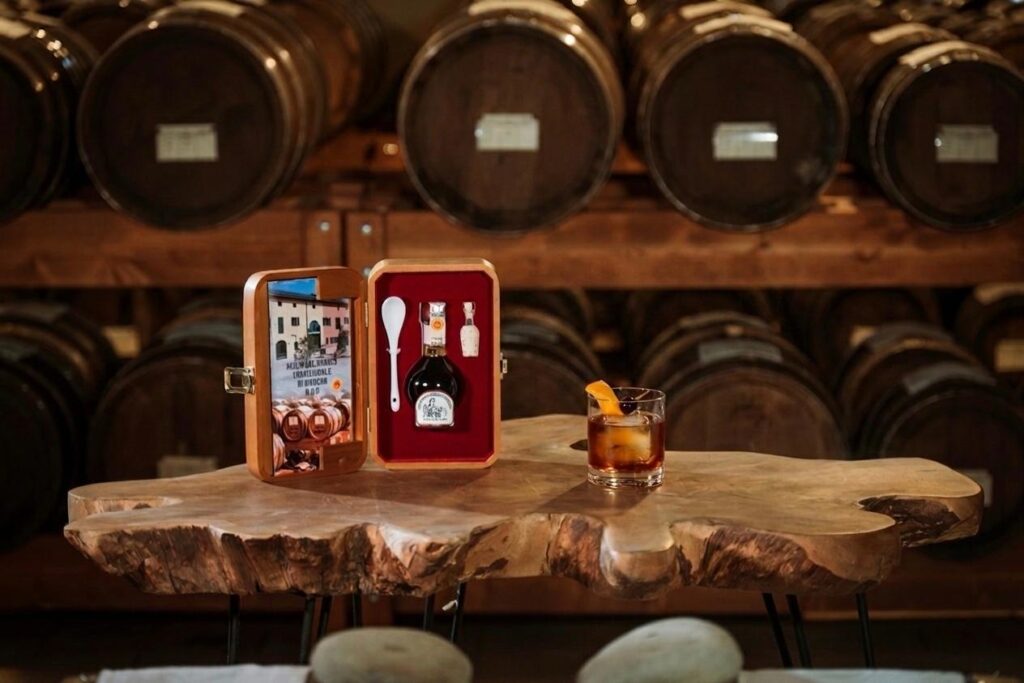
What is meant by the term “battery” of Balsamic Vinegar? This concept refers to the collection of Modena Balsamic Vinegar barrels that families kept at home, traditionally in the attics of homes, where it is possible to make the most of the significant temperature variations. The battery usually has an odd number of barrels, arranged from largest to smallest, and the balsamic ages inside all of them for a predetermined number of years: this process can last entire generations.
Tradition once dictated that a new battery be built and started for each daughter born, and that the girl, once an adult, bring it as a dowry: balsamic, therefore, represented a real asset for the family. Furthermore, many drums often had a female name: this testifies to the fact that the terminology of the balsamic world is closely linked to women. Some examples? The term “Mother of Vinegar”, which indicates the film that forms on the surface of the barrels, or “Mother Barrel” or “Abbess”, which refers to a large barrel that powers the other batteries.

A stone on the barrel
In traditional vinegars or in some photos of ancient vinegars, there is a stone on each wooden barrel. This is because it was once customary to close the barrels with a stone, which traditionally came strictly from the Panaro or Secchia river, with the belief that this measure served to give the vinegar the traditional flavor that distinguishes it. The reason? The irregular shape of the river stone allows a little’ air to pass through, which allows the vinegar to breathe and therefore oxygenate to ferment and be affected by temperature variations.
The gauze present on the barrel hole, however, serves to protect it from the ingress of any impurities. Today this tradition is no longer followed, but in each battery the closing of the barrels maintains the correct conditions for storing the vinegar, allowing the passage of air.
The perfect tasting of Balsamic Vinegar
How to best savor the characteristics of Modena Balsamic Vinegar? Connoisseurs never use a metal spoon, because this causes vitamin C to react with oxygen and gives the balsamic ferrous notes that alter its flavor. In fact, it is better to use a ceramic spoon, because this material is devoid of any characteristics that could influence the tasting process and allows you to better appreciate the gustatory and olfactory characteristics of this product.
The oldest method involves using your fingers, placing a few drops of Balsamic Vinegar between your thumb and forefinger. In this way, the warmth of the skin makes the peculiarities of the balsamic clearer and the taste will be enhanced.
Who is the oxologist?
This technical term indicates the expert in Balsamic Vinegar: the word “oxologo” derives from the Greek “oxos” which indicates, precisely, vinegar. This professional is committed to patiently following all stages of balsamic production, from cooking the must to bottling. These experts are driven by a great passion for this product, and they put a lot of care and attention into their work: respect for traditions and preparation is, therefore, fundamental.
Acetaia Marchi
The fathers of balsamic
Three main figures made Modena’s Balsamic Vinegar great: the physician and naturalist Antonio Vallisnièri, who studied the characteristics and beneficial properties of this extraordinary product and who in the 18th century noted that as early as 1288, some documents attested to the presence of balsamic in the court of Obizzo II d’Este. Also of great importance was the producer Francesco Aggazzotti, who in 1862 wrote to the lawyer Pio Fabriani the perfect formula for obtaining an excellent balsamic, which is still the starting point of the specifications today.
Finally, it is also necessary to mention the chemist Fausto Sestini, who in 1863 carried out the first scientific study on the product, determining its chemical composition and fundamental characteristics that distinguished it from other vinegars present in the world.
The passion of Acetaia Marchi
Balsamic Vinegar represents a very important Italian cultural and traditional heritage, which is passed down from generation to generation and which carries with it’ a great number of curiosities and peculiarities. Due to its versatility, today we at Acetaia Marchi love to use it in a wide variety of ways, making it the protagonist of special events in the form of, for example, a food and wine favor, or sharing it as a gift in a gift box. In any capacity, it still remains a key piece of local history and a priceless product.
If you are interested in trying our products, come and visit us in our Bottega in Modena: here you can try the Balsamic Vinegar of Modena PGI, Traditional Balsamic Vinegar of Modena PDO and the Balsamic Condiments of our production, and you can get advice from our expert master acetai. What are you waiting for? Come visit us!